Multi-View 3D Reconstruction
Benchmarking 3D-R2N2, Pix2Vox and TripoSR on sparse-view reconstruction, with an adaptive method-selection strategy.
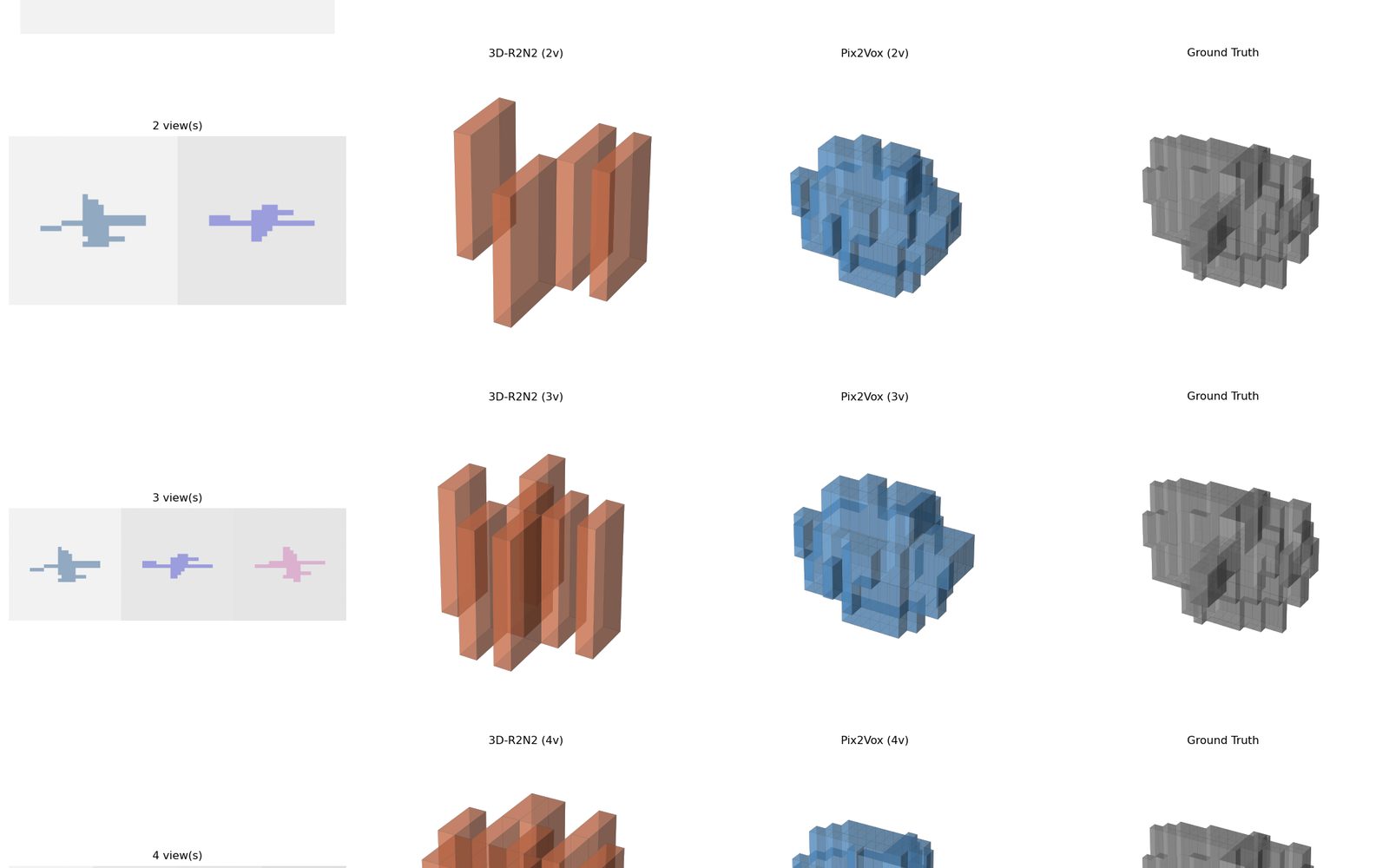
Reconstructing 3D geometry from a handful of 2D views is ill-posed — depth is ambiguous and parts of the object are simply never seen. This project measures how reconstruction quality actually evolves as views are added, from one to five, and compares two different answers to the fusion problem.
3D-R2N2 fuses recurrently: a 3D-GRU refines a voxel grid as each view arrives. Pix2Vox is context-aware: a scoring network weights each view's contribution adaptively. We implemented both in PyTorch, evaluated on ShapeNet across airplane, car and chair categories with IoU and F-score, and added TripoSR as a modern single-image baseline.
The comparison motivates an adaptive selection strategy — the right method depends on how many views you have and how much they overlap, and the crossover point is measurable.
Highlights
- Full PyTorch implementations of 3D-R2N2 and Pix2Vox evaluated on 32³ voxel grids.
- IoU and F-score across 1–5 input views on three ShapeNet categories.
- Synthetic procedural data generator so the pipeline runs without large downloads.
- Adaptive method-selection strategy derived from the view-count crossover.
Gallery